
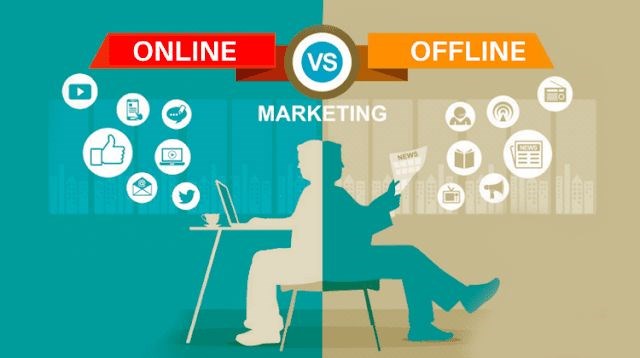
Online and offline marketing have several fundamental differences in the process and ability to execute. Offline marketing Conditional Use of The Marketing traditional media: print media, broadcast, direct mail and physical signs. It has generally wide local or regional reach but low targeting of the audience and accuracy of evaluation of performance. Marketing online relies on online platforms: research, social networks, electronic mail, websites and cell phones. It allows accessibility on a worldwide level, targeting and specific audience location, real-time analytics, engagement with the audience, and its tracking on the performance level. Cost structures too do vary where online will offer a more flexible and measurable budgeting. These differences in operations would be understood to make the selection of strategy and resource allocation much easier
Physical vs Digital Audience Reach
Geography limits physical audience reach, it can only engage local or regional audiences via channels such as print or outdoor advertising; scaling is very expensive. Digital audience access contributes to the global scale without limitations through the geographical location, such as the social media or search engine. Digital is specific, through demographic, interest and behavior targeting, Analytics is measurable and must have greater reach at reduced costs. The fundamental difference comes to unlimited range of scale and precision in targeting definition of digital compared to locality and fixedness of physical.
Cost Differences: Traditional vs Digital
Traditional marketing has greater fixed expenses, necessitating a large initial outlay since it involves tangible production (printing and materials) and placement (TV slots, billboards and direct mail). There is poor targeting of audiences, resulting most of the time slippage of spend. In contrast, digital marketing requires fewer costs to become a member, and most of its costs are variable and depend on such models as pay-per-click. Costs increase congruently with expansion or interest via mediums that include social media advertising, and email marketing. The work lets one achieve granular targeting of the audience, conduct real-time budget changes, and have quantifiable ROI, which usually leads to increased efficiency over conventional practices.
Measurable Results vs Estimated Impact
The results of online marketing can be measured using digital analytics because in online marketing, specific actions such as clicks, conversions, engagement, and ROIs can be directly attributed. The offline marketing will be based on estimated impressions since such media as the TV, print or a billboard will have no natural tracking on its own. Their success is indirectly assessed via such proxies as coupon redemptions, special phone lines, or qualitative market research linking actions and sales changes together, which must be evaluated in interpretive terms.
Interactive vs Static Communication Channels
Interactive communication mediums allow a two way interaction between the businesses and the audience. Online marketing uses such facilities (e.g. social media, live chat, email) to provide feedback, personalization and building relationships in real-time. One way communication channels provide non-interactive messages with no response by the audience. The purpose of offline marketing is to distribute a fixed message to a large group of people by using mainly static channels (e.g. print advertising, billboard, TV commercial). The fundamental difference is the existence of conversation: dynamic channels of communicating allow people to enjoy real-time interchange online, whereas lifeless channels allow sending controlled and non-resective≤Gappa (2011). This disparity essentially affects the possibilities of engagement and the flexibility of the campaign.
Speed and Flexibility Comparison
Online marketing can integrate high-speed campaign delivery and changes. It is possible to launch, adjust, or terminate campaigns in a matter of time using the performance data. Acceptance of budgets and audience targeting can be changed at short notice. Offline marketing means using the physical medium (print, direct mailing), or the reserved media (TV, radio). This necessitates a longer production lead time, distribution and scheduling lead time. Finally, it is hard and slow to change something when a campaign is already running. Online marketing has much higher speed and flexibility in its operations as compared to offline.
Conclusion
Online and offline marketing are different in their implementation and audience engagement. Online marketing uses digital channels as an online marketing media, so specific target audiences can be used, campaigns can be globally distributed, real-time changes can be made in campaigns, and their performance can be measured. Offline marketing involves use of physical resources and channels, which means a tangible brand experience and local face-to-face contact by customers. The offline techniques also have a sensory quality that will provide a unique memorability in territorial specificity. The online channels are scalable and able to provide analytics, whereas the offline channels offer the real world and the physical experience. It is important to note these natural differences in order to be successful in strategy making in marketing.


Leave Comment